
If you’re not strength training, you’re not a complete runner.
I know that’s harsh. But it’s true.
Running breaks your body down. Strength training builds it back up stronger.
You need both.
After 17 years in fitness and seeing countless runners sidelined with preventable injuries, I can tell you with absolute certainty: the runners who strength train consistently are the ones who stay healthy and keep progressing.
The ones who don’t? They plateau, get injured, or both.
Let’s fix that.
Why Runners NEED Strength Training
Most runners resist strength training because:
- “I don’t have time”
- “I’m already tired from running”
- “I don’t want to get bulky”
- “Running is my cardio”
I get it. But here’s what strength training actually does for runners:
1. Prevents Injury
Running is repetitive impact. Thousands of steps, same movement pattern, over and over.
If your muscles, tendons, and connective tissue aren’t strong enough to handle that load, something breaks.
Common running injuries caused by weakness:
- Shin splints (weak calves and tibialis anterior)
- Runner’s knee (weak glutes and quads)
- IT band syndrome (weak glute medius and hip stabilizers)
- Plantar fasciitis (weak feet and calves)
- Achilles tendinitis (weak calves and poor eccentric strength)
Strength training addresses the muscular imbalances and weaknesses that lead to these injuries.
2. Improves Running Economy
Running economy = how much energy you use at a given pace.
Better running economy means you run faster with the same effort (or the same pace with less effort).
Studies show strength training improves running economy by 3-8%. That might not sound like much, but over a 10K or half marathon, it’s massive.
3. Increases Power and Speed
Stronger muscles generate more force with each stride.
More force = more power = faster running.
Especially in the final miles of a race when you’re fatigued, strength makes the difference between fading and finishing strong.
4. Protects Joints
Your muscles act as shock absorbers. Stronger muscles = less stress on joints.
This is especially important as you increase mileage or age. Joint health is long-term running health.
5. Fixes Imbalances
Most runners are quad-dominant with weak glutes and hamstrings.
This creates compensation patterns that lead to poor running form and injury.
Strength training balances these imbalances.
How Often Should Runners Strength Train?
Minimum: 2x per week, 20-30 minutes each
Ideal: 2-3x per week, 30-40 minutes each
Maximum: 3x per week (more than this interferes with running recovery)
When to do it:
- On easy running days (after your run)
- On rest days
- Never the day before a hard running workout or race
The Essential Exercises Every Runner Needs
These exercises target the muscles and movement patterns most critical for running.
LOWER BODY
1. Bulgarian Split Squats
Why: Builds single-leg strength (running is a single-leg sport). Strengthens quads, glutes, and stabilizers.
How:
- Back foot elevated on bench or chair
- Front foot far enough forward that knee doesn’t pass toes (this activates the quads too much – we want glutes)
- Lower until back knee nearly touches ground
- Drive through front heel to stand
- 3 sets x 10 each leg
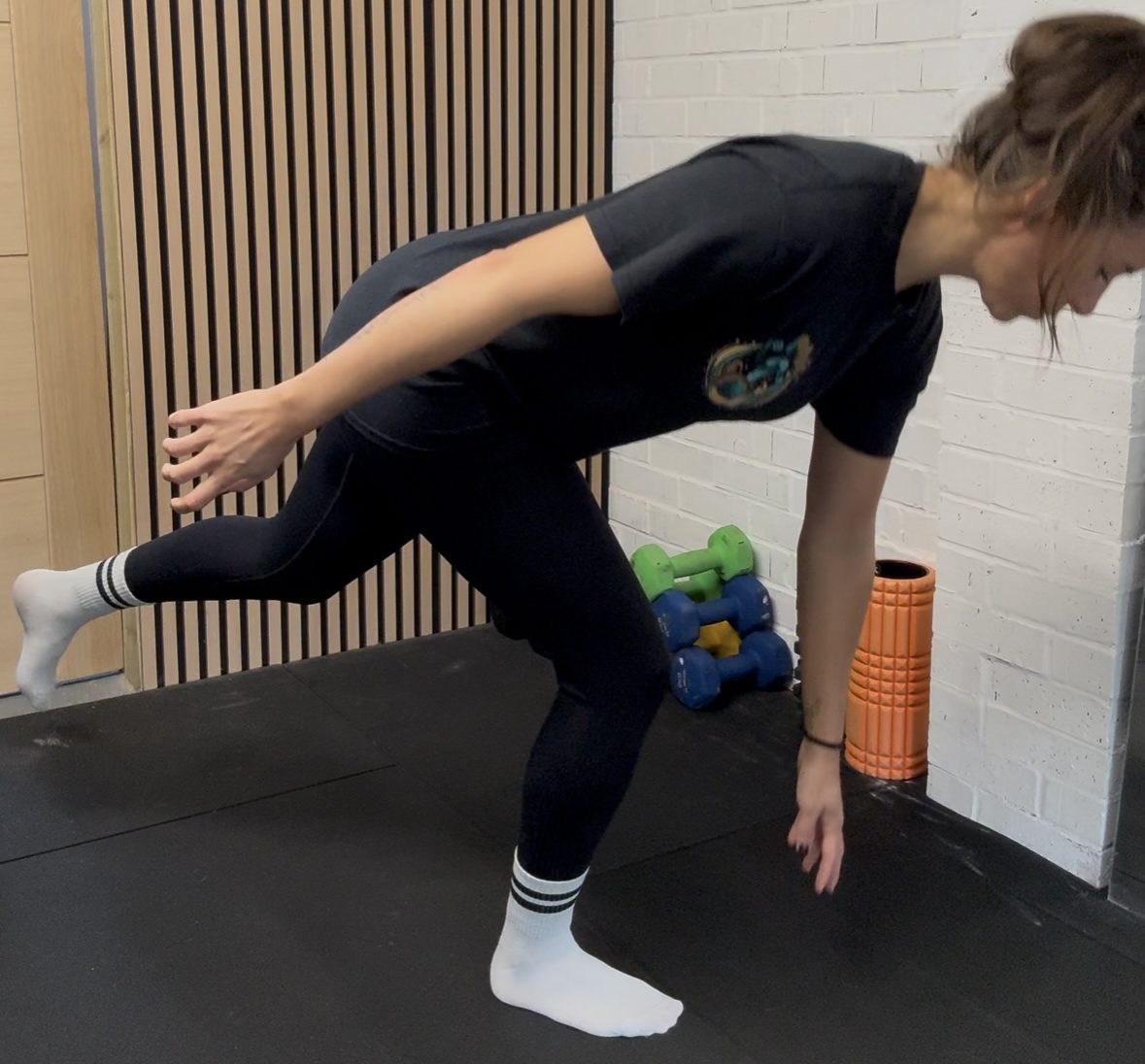
2. Single-Leg Deadlifts
Why: Strengthens hamstrings, glutes, and improves balance. Addresses common quad-dominance.
How:
- Stand on one leg
- Hinge at hips, reaching opposite hand toward ground
- Keep back flat, standing leg slightly bent
- Feel stretch in hamstring of standing leg
- Drive through heel to return to standing
- 3 sets x 10 each leg
3. Calf Raises (Single-Leg)
Why: Prevents shin splints, Achilles issues, and plantarfasciitis. Essential for push-off power.
How:
- Stand on one leg on edge of step
- Rise up on toes as high as possible
- Lower heel below step level for full range of motion
- Control the movement—don’t bounce
- 3 sets x 15 each leg
Bonus: Add eccentric focus (3-5 sec lowering phase) for extra Achilles protection
4. Step-Ups
Why: Builds quad and glute strength in a running-specific movement pattern.
How:
- Use a box or bench (knee at 90 degrees when foot is on box)
- Step up, drive through heel of elevated leg
- Don’t push off with bottom leg
- Step down with control
- 3 sets x 12 each leg
HIP & GLUTE EXERCISES
5. Clamshells (with resistance band)
Why: Activates glute medius, which prevents knee valgus (inward knee collapse—major cause of IT band and knee issues).
How:
- Lie on side, knees bent, resistance band around thighs
- Keep feet together, lift top knee
- Control the movement, don’t use momentum
- Feel it in side of glutes
- 3 sets x 15 each side
6. Fire Hydrants
Why: Strengthens glute medius and hip external rotators.
How:
- Start on hands and knees
- Keeping knee bent, lift leg out to side
- Knee should rise to hip height
- Control the movement
- 3 sets x 12 each side
7. Lateral Band Walks
Why: Strengthens hip abductors and glute medius in a functional pattern.
How:
- Resistance band around ankles or thighs
- Slight squat position
- Step sideways, maintaining tension on band
- Keep knees tracking over toes (don’t let them collapse inward)
- 3 sets x 15 steps each direction
CORE EXERCISES
Core strength is critical for maintaining good running posture, especially when fatigued.
8. Plank
Why: Builds anti-extension core strength. Prevents lower back pain and maintains posture.
How:
- Forearms on ground, body in straight line from head to heels
- Don’t let hips sag or pike up
- Squeeze glutes, brace core
- Breathe normally
- 3 sets x 45-60 sec
9. Side Plank
Why: Strengthens obliques and lateral core stabilizers.
How:
- On forearm, body in straight line
- Stack feet or stagger for easier version
- Don’t let hips drop
- 3 sets x 30-45 sec each side
Progression: Add leg lift for extra challenge
10. Dead Bugs
Why: Teaches core stability while moving limbs (exactly what happens when running).
How:
- Lie on back, arms straight up, knees at 90 degrees
- Lower opposite arm and leg toward ground
- Keep lower back pressed into floor
- Return to start, switch sides
- 3 sets x 12 each side
11. Bird Dogs
Why: Strengthens posterior chain and improves balance.
How:
- Start on hands and knees
- Extend opposite arm and leg
- Keep hips level, don’t rotate
- Hold for 2-3 seconds, switch sides
- 3 sets x 10 each side
Sample Strength Training Schedule
OPTION 1: 2x Per Week
Session A (Monday or Tuesday):
- Bulgarian split squats
- Single-leg deadlifts
- Calf raises
- Plank
- Side plank
Session B (Thursday or Friday):
- Step-ups
- Clamshells
- Lateral band walks
- Dead bugs
- Bird dogs
OPTION 2: 3x Per Week
Monday: Lower body focus (squats, deadlifts, step-ups)
Wednesday: Core & hip focus (planks, clamshells, lateral walks)
Friday: Full body maintenance (pick 5-6 exercises, 2 sets each)
How to Progress
Week 1-2: Learn the movements with bodyweight only
Week 3-4: Add resistance (light dumbbells, bands)
Week 5+: Gradually increase resistance every 2 weeks
Signs you’re ready to progress:
- Current weight/resistance feels easy for all reps
- You can complete all sets with perfect form
- You’re not overly sore the next day
Common Mistakes
❌ Skipping strength training during race training → This is when you need it most
❌ Going too heavy → Focus on form and control, not max weight
❌ Only doing upper body or “fun” exercises → Stick to running-specific movements
❌ Doing strength the day before a hard running workout → Schedule it strategically
❌ Stopping strength training once you feel strong → It’s maintenance for life, not a phase
When to Strength Train During Your Running Schedule
Easy running days: Strength train after your run
Rest days: Strength train anytime
Hard running days (tempo, intervals, long runs): No strength training
Day before hard workout or race: No strength training
Race week: Light strength only (maintenance, not fatigue)
“But I Don’t Have Time”
You have time.
20 minutes, 2x per week = 40 minutes total.
That’s one TV episode. One social media scroll session.
You’re not too busy. You’re choosing not to prioritize it.
And that choice is costing you: time sidelined with injury, plateaued progress, frustration.
The runners who stay healthy and keep improving? They make time.
Your Action Plan
- Schedule 2 strength sessions this week (put them in your calendar)
- Start with bodyweight versions of all exercises
- Focus on perfect form over speed or reps
- Be consistent for 4 weeks before judging results
- Never skip strength training during peak training—that’s when you need it most
Need a Complete Plan?
My 12-Week Ready-Made Running Plan includes structured strength training 2x per week, integrated perfectly with your running schedule.
[Link to plan]
Or if you want personalized strength programming based on your specific weaknesses and injury history, let’s talk about 1-1 coaching.
[Link to coaching page]
Stay strong.
Natalie
Leave a Reply